In his first address to the nation, President Obama vowed to make health care reform a reality so that employers would "no longer be burdened by the crushing weight of health care costs." These costs affect every company that offers health care benefits, and the costs continue to increase. In 2008, health care spending in the United States was $2.4 trillion, up from $1.9 trillion in 2005; meanwhile the number of health care claims reached a record high in 2008. This sobering reality reflects the increased demand for health care services due to the worsening health status and aging population, as well as the increased cost of actual care. Employers need a health care plan that aligns costs with results, such as services that actually improve the health of employees and their dependents.
In the United States, most employer-sponsored health plans reflect a sharing of costs with employees, and both groups have incurred enormous increases throughout this decade.Employer premiums continue to increase year-over-year; in 2005, they increased by 9.2%, nearly three times the rate of inflation. Some employers have tried shifting rising costs to employees, but this trend simply transfers the burden onto workers, forcing many to abandon their jobs or health care coverage. Since 2000, employee contributions to health care premiums have risen by 143%, and employee co-payments have increased by 115%. Shifting costs may offer employers a temporary solution, but it fails to address the actual sources of rising health care costs.
Rising health care costs have a broad economic impact in the lives of many Americans and their communities. A study of the effects of debt on housing security found the housing crisis is due in large part to medical debt, including people’s inability to make rent or mortgage payments, and their incursion of bad credit ratings. Another study concluded that increasing employer and employee health care costs led to the onset of the current economic downturn, as high costs forced companies to reduce spending and cut workforces. Analysts suggest that without a viable solution, annual U.S. health care spending will exceed $4 trillion by 2015.
Despite the continuing increases in health care costs and health claims, the health of Americans continues to worsen. Compared to 20 years ago, Americans as a whole are less physically active, work longer hours, and consume more processed and calorie-rich foods. The proliferation of technology has brought new ways of working and has reduced the amount of physical labor needed to perform the same jobs. As a result of these new lifestyles, individual health continues to decline.
According to a New York Times article, the key factor for the decline in health is due to obesity, which also links to an increased risk of most chronic diseases. As obesity rates increase, so do the rates of illness and chronic disease. In 1986, no state reported having an obesity rate among adults at or above 15%; by 2006, all states reported obesity rates among adults at 15% or higher. Likewise, rates of diabetes, heart disease, high blood pressure, and cancer have also risen; today, 130 million Americans are living with at least one chronic illness. These conditions are among the leading causes of death, and collectively are among the most costly to treat.
A significant side effect to employers of their employees’ poor health is presenteeism, which refers to lost productivity from workers who are on the job but not at full health. A study on health and productivity quantified presenteeism by calculating that employers absorb at least $2 of health-related productivity costs for every $1 they spend on a worker’s medical or pharmacy costs.
As the health status of employees continues to worsen, employers struggle for ways to manage the increasing health and productivity costs related to poor health.
To be sure, reforming health care is not a one-step process; it calls for a multi-disciplinary approach. It requires changing the way health issues are viewed to discover new ways to solve the crisis.
Research indicates the solution lies in a comprehensive strategy that combines efforts by employers and the health care system to improve the health of the workforce. Specifically, a health promotion program in the workplace is fundamental to achieving positive results. This kind of "worksite" program actively engages persons in their own personal health, helps at-risk persons lower their risk of chronic disease and illness, and supports those with already established disease receive evidenced-based care.
Identifying at-risk patients is crucial to helping prevent chronic disease, which accounts for 75% of all health care costs. This innovative approach assists in improving health literacy, addressing modifiable health risks, and supporting access to health care for individuals and their families where needed. This approach also helps reduce the disease burden, decrease the need for health care, and provide intervention or treatment for those with or at risk of disease, in a timely and cost-effective manner. Ultimately, health and productivity costs are lowered.
Many qualitative studies have examined worksite health promotion services to identify the key elements required to save costs. One study analyzed several programs and identified six best practices to create measurable and effective change:
| Best Practice | TotalCare |
| Organizational commitment | As part of the planning process, TotalCare engages all levels of management to help define and align program goals. Concentra also assists in developing an employee communication campaign that emphasizes the commitment of management and employee champions throughout the entire organization. |
| Incentives for employees to participate | Concentra assesses the company’s culture and employee population to determine which incentives would be most effective, and then recommend an incentive plan accordingly. |
| Effective screening | Concentra’s nationwide reach means 100% of an employee population can be screened through workplace events, mobile medical units, Concentra Medical Centers, and a network. Concentra’s systems enable fast processing of results, personalized health reports for each participant, summary reports to employers, and maintaining strict patient confidentiality throughout the process. |
| Evidence-based interventions | Concentra Health Specialists employ evidence-based, effective marketing, coaching and education techniques to promote health practices and compliance with disease management. Concentra’s targeted lifestyle support curriculum incorporates the proven Acceptance and Commitment Training (ACT) principles in sustaining desired behavior change among participants. |
| Effective implementation | Concentra’s operations team works with employers to implement each component of TotalCare effectively. As with the above best practices, management commitment and effective communication are crucial to successful implementation. |
| Ongoing program evaluation | Concentra performs ongoing testing of participants and provide ongoing metrics of all services to enable employers to evaluate each TotalCare component and calculate their returns. |
| Health marketing | Following the initial population-based screening, a 12-month health promotion campaign is designed to address the risk burden affecting the workforce. Leadership and promotion campaigns are implemented to best reach the workforce and support a culture of health. |
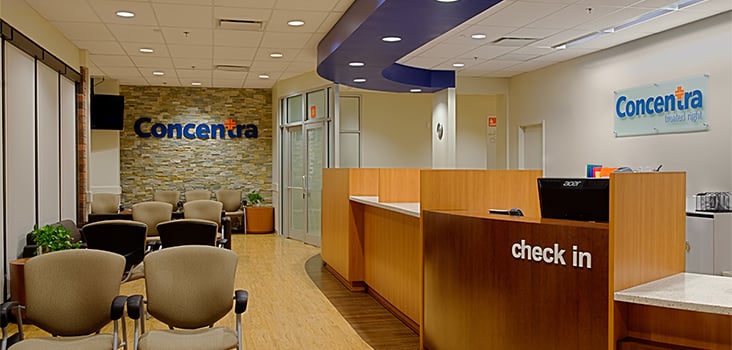
Those best practices are made even more effective when enhanced by a worksite health center, which is a medical center located in the workplace that offers a customized menu of health care and wellness services designed for that specific employee population. An employer can benefit from a centrally located worksite health center that minimizes the time employees spend away from work, facilitates their access to health care, and reduces or eliminates their out-of-pocket cost for treatment. The end result is improved health and wellness for employees due to convenient and cost-effective care delivery, and a high return on investment (ROI) for employers as health care costs continue to drop year after year.
The cost effectiveness of worksite health improvement services has been examined in several recent studies, with all studies concluding there are significant positive results for employers and patients. One study looked at several worksite wellness efforts and calculated a $3-$6 ROI for every $1 invested over a 2-to-5-year period. Another study focused specifically on worksite-based clinics and concluded that a worksite-based clinic provides services to employees 2 to 3 times more cost effectively than do off-site facilities.
Additional analysis by a leading health care firm concluded that worksite health promotion programs reduce average sick leave, health plan costs, workers’ compensation costs, and disability costs by 25%. Many researchers have remarked that this approach to health care represents an efficient way to increase access and affordability of medical care, while reducing the burden of cost on employers.
Concentra responded to the need for an effective, efficient workplace health promotion program by creating the TotalCare service. Concentra incorporated all the best practices identified by research (see Breakout Box), and designed a program especially for employers. The service offering can be customized to meet the unique needs of a workforce, and it can be implemented in stages to enable employers to adopt a "pay-as-you-go" approach. TotalCare provides employers with a best-in-class solution that protects and cares for their greatest asset: their employees.
The typical first step in TotalCare is establishing a Health Improvement Program, which uses health and risk assessments and screenings to provide participants with detailed health information, including the potential for chronic disease. This proven process includes assessment for cardio-metabolic disease risk by examining five health measurements – blood pressure, waist circumference, fasting glucose, triglycerides, and HDL cholesterol – and identifying at-risk participants as those who have at least three measurements in the unhealthy range. For participants scoring in the possible disease range for any single parameter, this approach facilitates their timely referrals for follow-up medical evaluation.
Concentra recognized a defining moment in the health care process: identifying employees who are at-risk and using that information as an opportunity to influence behavior change. If at-risk employees are educated about their health and actively supported to change their behaviors to lower their risk levels, the costs associated with chronic disease can be averted. Approximately 33% of a typical U.S. workforce have at least three unhealthy measurements and are therefore likely to develop chronic disease(s) and become future health care claimants. TotalCare changes the way patients view their health and empowers them to become active participants in the improvement process. With this focus, TotalCare has a tremendous opportunity to both save lives and reduce cost.
As part of their feedback from the Health Improvement Program, at-risk employees are enrolled into a multi-step program to improve their health. This important TotalCare component utilizes health marketing, coaching, education, and promotion to challenge employees to change behaviors and make healthier choices. To help realize the greatest value of the program, Concentra works with employers to communicate and design employee incentives that fit within the company’s culture and further motivate employees to participate. The result is a health-centered organization that tangibly supports wellness among its employee population.
Concentra is one of the few companies to fully utilize Health Specialists in the role of coach, educator, and facilitator. These certified professionals offer combined expertise in wellness, nutrition, fitness, life coaching, and motivation. Health Specialists provide one-on-one and smallgroup interaction with participants and lead the targeted lifestyle support curriculum, which includes classes on weight management, fitness and nutrition, and lifestyle support for diabetes. Health Specialists help identify health concerns, facilitate timely referrals, and support adherence to current treatment plans. These health-promotion program elements are also available to participants through an innovative set of tools that include phone and Web-based access.
As a truly customized solution set, TotalCare can be delivered to employees through Concentra’s expansive network of over 300 Concentra Medical Centers, mobile medical units, worksite clinics, and other delivery methods. TotalCare also offers the option of a dedicated worksite health center, where the entire solution set can be delivered on-site to employees, as well as traditional health services that include occupational health, group health, urgent care, and primary care. The central location of the health center helps increase employee utilization of health and wellness programs as employers benefit from minimized employee downtime and lower fixed costs.
The TotalCare program was introduced in 2007 and has gained in popularity among health care brokers and large employer-clients. Although the comprehensive solution has not been in existence long enough for multi-year ROI studies, clients who have implemented the TotalCare program have seen results that validate the external studies in proving the effectiveness of worksite health promotion programs.
For example, Concentra helped implement a worksite health program at Hannaford Brothers Company, one of the largest grocers in New England. The program focused on engaging employees and motivating them to make positive lifestyle changes. According to Hannaford’s Manager of Wellness Initiatives, the company has seen increased participation in health promotion activities, decreased employee health risk factors, and a decrease of more than 6% in health care costs, largely because of this program.
Elsewhere, Concentra introduced Worksite Athletic Health Specialists in a distribution center of a nationwide drug store chain to engage employees in several wellness efforts, including exercise and safety. At the beginning of this program, the facility’s DART rate ("Days Away, Restricted or Transferred") was 18, which was more than three times the industry average. Less than two years into the program, the facility’s DART rate has been reduced to 4, and its workers’ compensation costs have decreased significantly.
Both internal and external evidence demonstrates the effectiveness of results-oriented worksite health promotion and health center services, such as Concentra’s TotalCare program. What sets Concentra apart is the depth of expertise its 30 years in health care brings to the service, its robust array of services and geographic reach, and its ability to implement a customized offering specific to each employer’s workforce. Given the company’s history of occupational health care expertise and the proven results the TotalCare program delivers, more employers are turning to Concentra to help combat the problem of rising health care costs.
1 Keehan, S. et al. "Health Spending Projections Through 2017," Health Affairs Web Exclusive W146: 21 February 2008.
2 The Kaiser Family Foundation. Employer Health Benefits: 2005 Annual Survey. June 2005.
3 The Henry J. Kaiser Family Foundation. Employee Health Benefits: 2008 Annual Survey. September 2008.
4 The Access Project. Home Sick: How Medical Debt Undermines Housing Security. Boston, MA, November 2005.
5 The Business Roundtable Health Care Value Comparability Study Executive Summary. 03 March 2009.
6 National Coalition on Health Care – Keehan, S. et al. "Health Spending Projections Through 2017," Health Affairs Web Exclusive W146: 21 February 2008.
7 Taubes, Gary. "Do We Really Know What Makes Us Healthy?" New York Times: September 16, 2007.
8 "U.S. Obesity Trends 1985-2007." Centers for Disease Control and Prevention Web site: http://www.cdc.gov/obesity/data/trends.html
9 ACOEM Guidance Statement: Healthy Workforce/Healthy Economy: The Role of Health, Productivity, and Disability Management in Addressing the Nation's Health Care Crisis.
10 "Economic Consequences [of Obesity]." Centers for Disease Control and Prevention Web site: http://www.cdc.gov/obesity/causes/economics.html
11 Loeppke, Taitel, Haufel, Parry, Kessler, and Jinnett. "Health and Productivity as a Business Strategy: A Multiemployer Study" (April 2009).
12 American Public Health Association, et al., The Collaboration for Estimating the Cost of Chronic Disease Web site: http://www.chronicdiseasecollaboration.org
13 "Prevelance of Obesity Among Working Age Adults." Milliman analysis of NHANES data (November 2007).
14 Koffman, Goetzel, Anwuri, Shore, Orenstein, and LaPier. "Heart Healthy and Stroke Free: Successful Business Strategies to Prevent Cardiovascular Disease" (2005).
15 Chenoweth and Garrett. "Cost-Effectiveness Analysis of a Worksite Clinic: Is It Worth the Cost?" (February 2006).
16 Chapman, Larry S. "Meta-Evaluation of Worksite Health Promotion Economic Return Studies: 2005 Update" (July 2005).
17 Goetzel, Roemer, Liss-Levinson, and Samoly. "Workplace Health Promotion: Policy Recommendations that Encourage Employers to Support Health Improvement Programs for their Workers" (December 2008).